Insights · Event Technology
Imagine two delegates attending the same conference. One is looking for potential business partners; the other wants to learn, discover new ideas and explore opportunities for growth. They attend the same sessions, receive the same updates and access the same event information. Yet, their reasons for being there are entirely different.
By Alfred Mwangi | Lead IT & Digital Strategist, Zuri Events and Africa MICE Hub
This raises an important question for the MICE industry: how do we create experiences that recognise individual needs while bringing hundreds, or even thousands, of people together?
As expectations evolve, attendance alone is no longer enough. Delegates want relevance, meaningful connections and value that extends beyond the event itself. Event platforms are increasingly helping organisers respond to this demand, but their true potential lies in much more than digitising the event experience.
Beyond registration and event management
Event technology has traditionally focused on operational efficiency: simplifying registration, managing programmes, processing payments and making information accessible. These functions remain essential, but an efficiently managed event is not necessarily a personalised one.
A platform can register thousands of attendees without understanding what they hope to achieve. It can display an extensive programme without helping delegates identify the sessions most relevant to them. It can list hundreds of participants without making meaningful connections any easier.
The opportunity is to move from simply managing attendance to understanding participation.
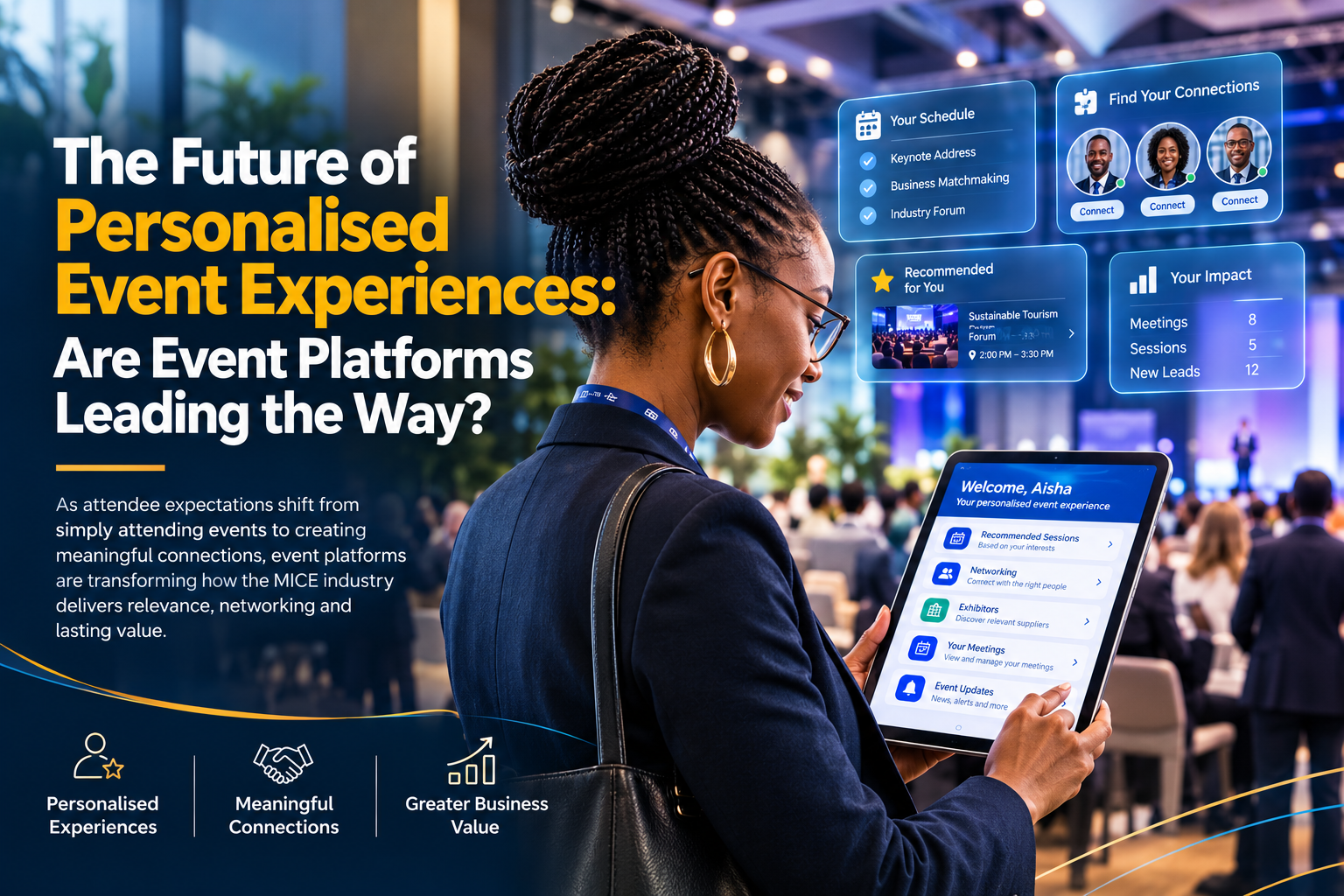
With relevant information and appropriate consent, platforms can help organisers tailor communication, recommend sessions, facilitate targeted networking and make opportunities easier to discover. A delegate interested in sustainable tourism, for example, could identify relevant discussions, exhibitors and potential partners without having to navigate an entire programme manually.
The difference is simple: instead of asking whether everyone has received the same information, organisers can begin asking whether people are receiving information that matters to them.
Making connections count
This is particularly important in the MICE industry, where the value of an event often extends beyond its content. For conferences, exhibitions and business forums, the right introduction can be just as valuable as the right presentation.
Consider a hosted buyer attending an international business event. Rather than relying entirely on chance encounters, the buyer could use an event platform to identify suitable suppliers, review participant profiles and schedule meetings aligned with specific business objectives. Exhibitors, in turn, could connect with prospects whose interests match their offerings.
The platform becomes more than a digital directory. It becomes an enabler of business opportunities.
For Africa's MICE industry, this presents a significant opportunity. As the continent strengthens its position in the global business events landscape, the ambition should not only be to attract more events, but also to deliver experiences that create lasting value for participants.
Technology can help bridge the gap between bringing people together and helping them achieve something meaningful when they meet.
However, a meeting booked is not necessarily a successful connection. The platform can facilitate the introduction, but the people involved determine what comes next.
Technology must serve the experience
Personalisation does not happen simply because an organiser adopts a platform with impressive features. It requires thoughtful planning, reliable information and a clear understanding of the audience.
Recommendations are only useful when the underlying information is accurate. Networking tools work best when participants have meaningful profiles and clear objectives. Notifications become a distraction when they are excessive or irrelevant.
The most effective platform is therefore not necessarily the one with the most features. It is the one that solves the right problems for the people using it.
This also means looking beyond the event day. Before an event, technology can help delegates prepare, discover relevant opportunities and plan meetings. During the event, it can support navigation, communication and engagement. Afterwards, it can help participants revisit resources and continue conversations.
When these stages connect, the experience becomes a journey rather than an isolated occasion.
Yet technology must not replace the human element. Some of the most valuable event moments happen spontaneously: a conversation after a presentation, an unexpected introduction or an idea sparked by a question from the audience. The goal is not to automate every interaction, but to remove unnecessary friction so that meaningful interactions can happen more easily.
Personalisation requires responsibility
The more platforms rely on attendee information, the more important privacy, cybersecurity and trust become.
Personalisation should not justify collecting unnecessary data or sharing information without appropriate permission. Organisers must be clear about how information is used, who can access it and how it is protected.
Accessibility matters, too. Not every participant has reliable internet access, the same digital skills or the same ability to use a particular device. A digital-first approach should make participation easier, not introduce barriers for those who need alternative ways to access essential information.
Technology should widen access to the event experience while respecting the people it serves.
Measuring what matters
Personalised experiences also challenge organisers to reconsider how success is measured.
Registration numbers and attendance figures remain important, but they reveal only part of the story. Did delegates find relevant sessions? Did networking lead to useful conversations? Did exhibitors reach suitable prospects? Did participants continue their engagement after the event?
Event platforms can provide valuable insights into engagement and participation, helping organisers identify what works and where improvements are needed. However, data must be interpreted carefully. A meeting booked does not guarantee a business outcome, just as a session attended does not necessarily mean a useful learning experience.
The strongest approach combines platform data with participant feedback and a clear understanding of the event's objectives. Each edition can then build on lessons from the previous one.
So, are event platforms the answer?
Yes, but not on their own.
Platforms provide the infrastructure for more relevant communication, smarter networking and more connected event journeys. But technology cannot compensate for a poor understanding of the audience, an unclear event strategy or an experience that fails to deliver value.
The real opportunity lies in bringing technology, strategy and human insight together.
As data analytics, automation and artificial intelligence continue to evolve, event platforms will have greater potential to support intelligent recommendations, more relevant matchmaking and experiences that respond to individual needs. For Africa's MICE industry, this opens exciting possibilities for creating more connected, inclusive and valuable business events.
The question is no longer simply whether a platform can personalise an event. It is whether we are designing events around what people actually hope to achieve.
Because the future of event technology will not be defined by how many features we introduce, but by how effectively we use them to turn attendance into meaningful participation.
And perhaps that is where the next chapter of event experiences begins.